

In last week’s Axiom, I made a promise about this week’s edition:
Thousands of claims jobs open annually, yet the workforce is shrinking? Why is this? What can we do about it? We will dive a little deeper into these questions next week.
See?
Now, let us keep the promise. Shall we?
How do we reconcile the seemingly contradictory facts of workforce shrinkage and claims job openings?
By understanding these distinctions:
- Job openings measure movement.
- Workforce size measures capacity.
Those figures can move in opposite directions.
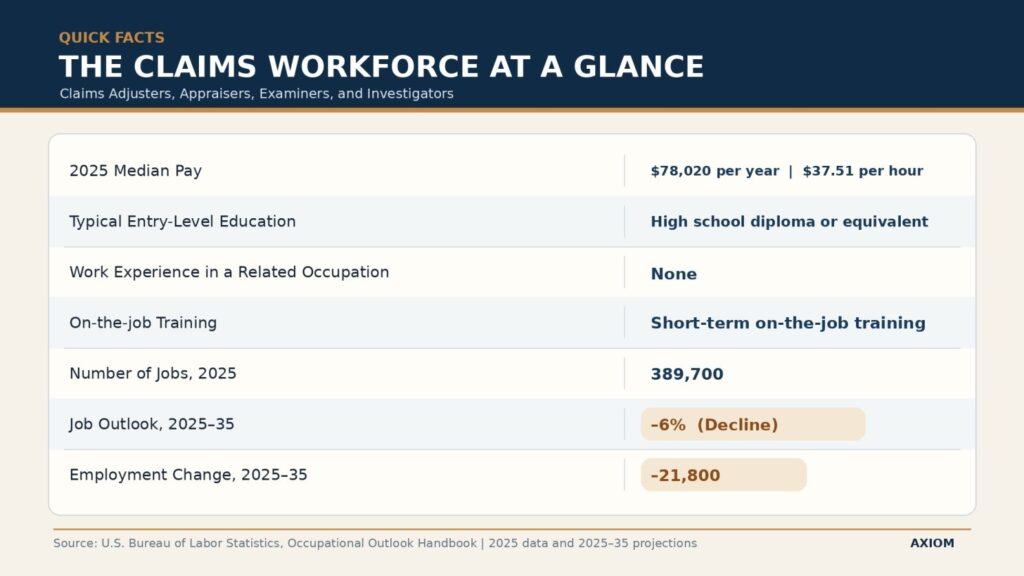
The Bureau of Labor Statistics projects about 21,600 openings each year for claims adjusters, appraisers, examiners, and investigators, while total employment falls from approximately 389,700 in 2025 to 367,900 in 2035—a 6% decline. The openings are expected to replace people who retire, leave the workforce, or transfer to other occupations. They do not represent 21,600 newly created positions.
The Big Picture
- 21,600 projected openings every year
- 21,800 fewer total positions by 2035
At first glance, the arithmetic appears contradictory, if not downright impossible. The difference, however, is between gross openings and net employment.
A business can replace thousands of departing workers while gradually eliminating positions at the same time.
Who’s Checking Out and Why?
Why are we losing claims professionals at what some in the independent adjusting sector consider an alarming rate?
There are some ready answers, such as retirement and AI.
This is an aging industry. We know this intuitively, but it is backed up statistically. Many claims professionals are retiring. The Bureau of Labor Statistics has roughly 33% of the workforce at age 55 or older.
AI is fully capable of doing administrative tasks that once required manpower. AI tools are increasing efficiencies, so the human jobs require fewer humans to achieve the same amount of production.
But how many are simply opting out? As the environment has become more unstable and the launching of careers in claims more difficult, how many give up out of the gate? On the independent adjuster side, we are seeing an increase in adjusters who get themselves licensed but never work their first storm. The reasons usually come down to a lack of opportunity or failure to access the best resources in terms of training, mentoring, and networking.
Technology is reducing the number of positions and possibly making new careers more difficult to launch, rather than easier.
The US Bureau of Labor Statistics specifically cites software, photographic estimating, faster data processing, and AI as reasons fewer workers may be required.
Mostly, simple tasks are currently targeted by AI:
- Simple losses
- Basic inspections
- Routine estimating
- File documentation
- Supervised settlement decisions
The rub comes when we understand these are the teething rings for baby adjusters. These are their training grounds. These areas are where knowledge and experience are gained. So, if these tasks are automated and/or eliminated, where does the rudimentary training and ground-level experience happen for the new adjuster?
Little Footnote:
To balance what may appear bleak, The Jacobson Group shared in a blog post titled Study Reflects a Steady Insurance Talent Outlook for 2026 that 50% of participating insurers planned to increase staffing, 43% expected to maintain it, and only 7% planned reductions. Claims remained an important hiring priority, including for entry-level talent.
The work is shrinking in volume but growing in difficulty
Routine claims are increasingly automated, centralized, remotely inspected, or segmented among specialists. While these require human-in-the-loop handling, there are fewer humans needed for the loops. Automated tasks can increase caseloads per adjuster.
The claims remaining wholly with human adjusters are more likely to be severe, disputed, technically complicated, or emotionally charged.
So, we are remaking the industry so that it may need fewer adjusters numerically but require more expertise — both in terms of technological acumen and claims handling ability.
Catastrophe demand does not follow a staffing forecast
A carrier can reduce permanent headcount because technology improves everyday productivity. It cannot schedule the next hurricane, wildfire, hail outbreak, or freeze.
This is the space where IA firms like Mid-America Catastrophe Services exist. It is not feasible for a carrier to employee a force of the size it will take to handle multiple regional catastrophes at once or one major catastrophe like a devastating hurricane. The ramp-up and ramp-down is too demanding.
BLS acknowledges that increasing natural disasters could sustain demand for field adjusters. The reasons may be unknown — or even unknowable — but BLS says natural disasters influence adjuster demand and that future increases could produce additional field demand.
One thing we do know is this: despite major strides in forecasting, we still cannot control the weather.
That creates a workforce built for ordinary efficiency but potentially unprepared for extraordinary demand.
The Greatest Threat to the Talent Pool
The greatest threat to the claims professional talent pool may not be that experienced people are leaving due to retirement, disillusionment, or in pursuit of greener pastures. The greatest threat may be that in pursuing the efficiencies of emerging technologies, we are dismantling the system that built those experienced people in the first place.
Some Real Solutions
- Build apprenticeships, not merely classes. This is a concern on which we are really focused at Adjust U. It is not enough to load a new adjuster with knowledge and tools. There needs to be mentorship because hands-on learning is where the lab learning is put to the test, where the real growth begins.
- Use AI to accelerate development, not eliminate it. Proper use of AI in training can give the learner immediate, in-depth, actionable feedback. It can provide a study guide and a career map. AI as an assistant trainer opens doors that were not only closed, but did not exist five years ago.
- Create a CAT bench and don’t forget them. Every carrier and IA firm works to make sure the resources are there when an event happens. But it is one thing to build a roster; it is another to engage with the people (real humans with real hopes and real needs) on the roster. Continuing education, local daily work, regional networking events, regular contact via newsletters, emails, and phone calls…to name a few ways to keep the bench warm.
- Recruit from complementary professions. Some of the best adjusters were roofers, builders, carpenters, military personnel (who understand the strains of deployment), and even ministers (people people), like yours truly.
- Measure the progress and retention of new recruits. Counting licenses and names on a roster (which are never really 100% accurate due to unknown movement) is a poor substitute for knowing who your people are, where they are, why they are where they are, what they need, and how you can give them what they need to succeed. Success is ground up. Remember that. Roster failure is firm failure.
What could spell disaster can also spell success. Rather than rushing to eliminate positiond willy-nilly, invest the technology in recruiting, training, progressing, and retaining the best talent. We may not need as many as we once did, but we need them to be better than they ever were.
That starts with leadership. With vision. With intention.
This article, written by Gene, originally appeared in the LinkedIn newsletter, Axiom.