

From Axiom, Principled and Poised. Powered by MACS
“Not all those who wander are lost.”
J.R.R. Tolkien
In today’s claims environment, many organizations are not wandering.
They are standing still.
And inertia now carries more risk than reward.
1. The Evolving Risk Landscape
The operating climate for claims has shifted materially.
Since 1980, the United States has recorded hundreds of billion-dollar weather and climate disasters, with cumulative losses exceeding $2.9 trillion. In the 1980s, the country averaged fewer than five such events annually. Since 2020, that average has risen to more than twenty per year. In 2023 alone, there were 28.
This is not a temporary spike. It is a structural shift.
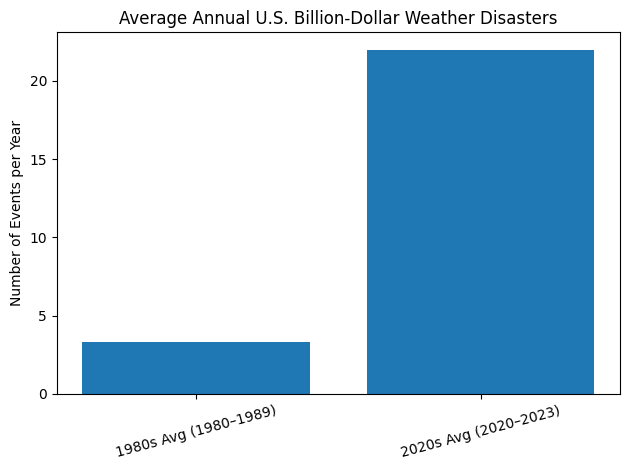
As event cadence increases, so does pressure on surge capacity, cycle time discipline, reserving accuracy, and documentation standards. Surge pressure isn’t just a seasonal anomaly; it’s the norm. When chaos is the norm, normal can feel chaotic. Everything is tested—every preconception, every conclusion, every tactic.
2. Why Human-Only Is No Longer Sufficient
Claims excellence has always depended on skilled professionals—field adjusters with construction fluency, desk adjusters with operational command, and reviewers with disciplined oversight.
That foundation remains.
What has changed is the margin for inefficiency.
When increased event frequency, workforce contraction, regulatory scrutiny, compressed policyholder expectations, and accelerating technology adoption converge, legacy workflows strain.
By 2023, the vast majority of U.S. insurers had implemented AI or machine learning in some component of claims processing. Robotic Process Automation now handles significant volumes of repetitive, rules-based tasks. More than half of insurers use predictive analytics to strengthen reserving accuracy.
These are not fringe experiments. They are embedded capabilities shaping speed, consistency, and leakage control across the industry.
A purely human model, unaugmented by disciplined systems, cannot scale at the pace the environment now demands.
3. Agency: Choice or Drift
Technology does not eliminate agency. It redistributes it.
Organizations that intentionally design workflows, define standards, and integrate data retain control. Those that delay adoption will eventually operate within systems defined by others — vendors, competitors, or regulatory pressure.
Agency in claims today means:
- Structuring how data flows from field to desk
- Embedding quality controls that reinforce judgment
- Integrating analytics into decision paths
- Automating repetition while preserving professional discretion
Without intentional design, operations drift — slower, inconsistent, reactive.
Drift feels safe. It rarely is.
4. Retreat Is Not an Option
There is no rewind button in claims operations.
The recent pattern of high-impact events reflects a new baseline, not an anomaly. Carriers and service partners must assume that volatility, exposure, and expectation pressure will remain elevated.
The choice is not whether to modernize.
It is whether modernization will be deliberate or forced.
5. Ownership Determines Outcomes
What we do not own, owns us.
If we do not own our data, we become reliant on forces beyond our control. If we do not own our surge model, events dictate our capacity. If we do not codify our standards, inconsistency defines performance.
Ownership is accountability. It is the ability to explain how decisions are made, defend why they were made, and refine how they are executed.
Embracing principles empowers the producer, informs the product, and increases production. Abandoning principles in the name of expedience threatens the process and weakens the product.
When operating principles are clear — about technology, talent, and process — adaptability is structured rather than reactionary.
Closing Thoughts: Why Axiom?
An axiom is a self-evident truth.
In logic, the Law of Identity states simply: A = A. A thing is what it is. Performance is what it is. Results are measurable.
At the end of the day, you are what your record says you are. – Hall of Fame NFL coach Bill Parcells
Another enduring truth is this: the only constant is change.
For claims organizations, these truths coexist and create a sort of tightrope. Standards must remain firm even as methods evolve.
At Mid-America Catastrophe Services, we believe thoughtfully-implemented, principle-guided innovation produces operational clarity, stronger cycle time performance, and enduring partnerships.
Fortes fortuna iuvat – Pliny the Elder. aka, “Fortune favors the bold.”
It means that success, luck, and prosperity come to those who take risks, act courageously, and pursue their goals. The timid and the hesitant are often left behind.
The future of claims will not necessarily belong to the largest organizations. It will belong to those disciplined enough to operate from first principles in a changing environment.
If you have not already, subscribe now to Axiom. We will stay abreast of industry trends and reflect on our place in a fast-paced world. You will receive insights, updates, and forecasts grounded in truth. You are invited to share your thoughts in the comments section and to share this publication with your friends.
My name is Gene Strother. And this is Axiom.